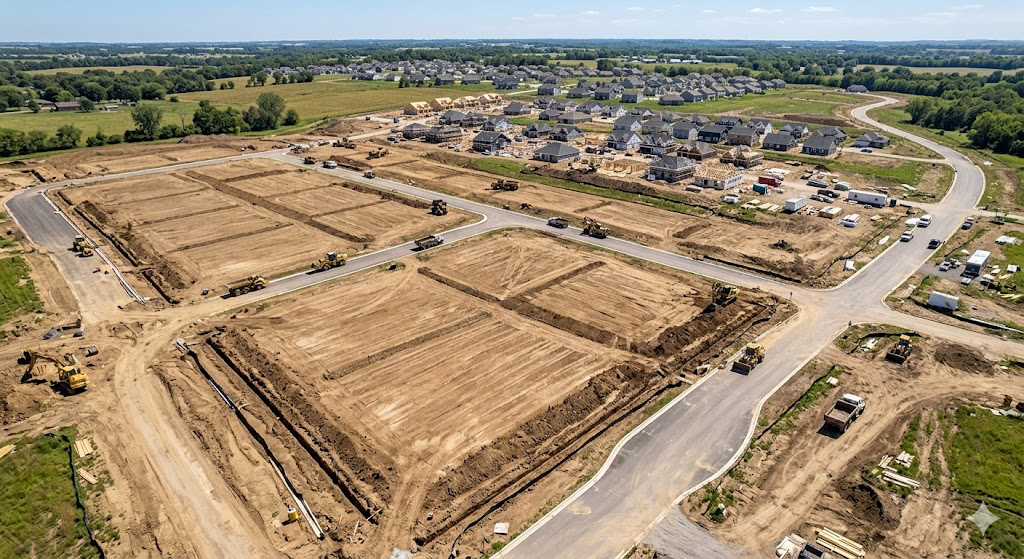
Before a single home can be sold in a new residential development, the streets have to be built. The water mains have to be in the ground. The sidewalks, storm drains, and fire hydrants have to be installed. But here is the problem every developer faces: all of that infrastructure takes time and money to build — and the lots sitting on top of it are the very thing the developer needs to sell to fund the work. A subdivision bond is the tool that breaks this deadlock. It lets the developer move forward, record the plat, and start selling lots before the improvements are finished — because the bond gives the municipality the financial guarantee it needs that the work will get done.
A subdivision bond is a type of surety bond required by a city or county before a developer can record a final plat or begin selling lots within a new development. It guarantees that the developer will complete all required public infrastructure improvements — streets, sidewalks, water mains, sewer lines, drainage systems, curb and gutter, fire hydrants, and utilities — in accordance with an approved development agreement and within a specified deadline. If the developer fails to complete the work, the municipality can file a claim against the bond to fund completion of the improvements without spending taxpayer dollars.
The Three Parties in a Subdivision Bond
Like all surety bonds, a subdivision bond is a three-party agreement. Understanding each party’s role clarifies how the bond functions in practice.
| Party | Role |
|---|---|
| Principal | The property developer or landowner who purchases the bond and bears the obligation to complete the improvements |
| Obligee | The city, county, or municipality requiring the bond to protect the public interest in infrastructure completion |
| Surety | The bonding company that issues the bond and guarantees to the obligee that improvements will be completed |
If the developer abandons the project, goes bankrupt, or simply fails to complete the improvements by the deadline, the municipality files a claim with the surety. The surety investigates the claim and either pays the cost to complete the work or arranges for another contractor to finish it. The developer is then legally obligated to reimburse the surety for all costs paid. This is not insurance — the developer always bears ultimate financial responsibility.
What Infrastructure Does a Subdivision Bond Cover?
The bond covers every public improvement specified in the subdivision development agreement. While exact requirements vary by municipality, the most commonly bonded improvements include streets and roadways, water mains and fire hydrants, sanitary sewer lines, storm drainage systems and detention basins, curb and gutter, sidewalks and pedestrian paths, utility lines (electricity, gas, telecom conduit), street lighting, and landscaping in public rights-of-way.
The bond amount is set by the local governing body — typically based on a licensed civil engineer’s itemized cost estimate, reviewed and approved by a municipal engineer. Developers should understand that this estimate can sometimes be negotiated if the initial figure appears inflated relative to actual market costs for the specific improvements required.
Why Subdivision Bonds Are Higher Risk Than Standard Performance Bonds
This is a distinction that catches many developers off guard. In a standard construction contract, if the project owner stops paying, the contractor can legally stop working. That protection does not exist with a subdivision bond.
Because a subdivision bond is a form of completion bond, the improvements must be completed regardless of whether the developer has the funds to pay for them. The surety has an independent obligation to the municipality to see the work through. This is why subdivision bonds carry higher premiums than standard contract performance bonds, and why many surety companies decline to write them at all. The financial risk to the surety is greater, the projects run longer, and the obligations stay open until a government inspector formally accepts the work.
The Critical Warning for General Contractors
This issue costs contractors money every year and almost no one talks about it clearly. A general contractor should never post a subdivision bond on behalf of a property owner or developer. If a GC obtains the subdivision bond as the principal, they take on an independent duty to the municipality to ensure the improvements are completed — even if the developer never pays them a dollar. The GC cannot stop work and walk away. They are bound to finish the improvements or face the full consequences of a bond default. The developer is the one who should always post the subdivision bond. The GC’s protection is the payment and performance bond they require from the developer, not the subdivision bond itself.
Other Names for a Subdivision Bond
The bond goes by many names depending on the municipality and the context:
| Name | When Used |
|---|---|
| Developer Bond | General term used by sureties and developers |
| Plat Bond | When the bond is tied specifically to plat recording |
| Site Improvement Bond | When covering a single commercial or private site rather than a full subdivision |
| Land Improvement Bond | Regional variation, same function |
| Completion Bond | Emphasizes the completion guarantee aspect |
| Improvement Bond | Generic term used by many municipalities |
Plat Bond vs. Subdivision Bond: Is There a Difference?
In many jurisdictions, the terms are interchangeable. However, some municipalities draw a distinction based on timing. A plat bond may be required at the point when the developer files the plat map — the document that legally divides the land into lots — which happens early in the approval process. A subdivision bond may technically refer to the bond covering physical construction of the improvements that follows after plat approval. Always confirm the specific terminology and timing requirements with the local planning or public works department before applying, because submitting the wrong bond form at the wrong stage can delay the entire project.
The Subdivision Bond Lifecycle: From Issuance to Release
Understanding the full lifecycle of a subdivision bond helps developers plan their projects and manage ongoing costs more effectively.
Stage 1 — Bond is required before plat recordation. The developer applies for the bond. The surety underwrites the application and issues the bond. The developer submits it to the municipality as a condition of recording the final plat and receiving approval to sell lots.
Stage 2 — Work proceeds. The developer begins constructing improvements. Because the bond is an annual obligation (not a one-time premium), the developer pays a renewal premium each year the bond remains open. This makes slow projects significantly more expensive.
Stage 3 — Bond reductions. As portions of the improvements are completed, inspected, and accepted, the developer can typically apply to the municipality for a partial bond reduction — reducing the bonded amount proportionally to the completed work. This is one of the most important cost-saving opportunities available to developers, yet many do not actively pursue it. Smaller remaining bond amounts mean lower annual renewal premiums.
Stage 4 — Final release. When all improvements are finished and accepted by a municipal inspector, the developer requests a full bond release. The municipality formally acknowledges completion and releases the surety and developer from all remaining obligations.
Stage 5 — The Defect Bond. Many municipalities require a separate bond after the main subdivision bond is released. This defect bond (sometimes called a warranty bond or maintenance bond) guarantees the workmanship and materials of the completed improvements for a period of one to two years from the date of municipal acceptance. Most developers are surprised by this second bond requirement. It is typically written at 10%–25% of the original bond amount and is a mandatory final step before the city or county accepts long-term maintenance responsibility for the roads, sewers, and utilities.
Multi-Phase Projects: The Smart Bonding Strategy
Large subdivisions are frequently built in phases. When possible, developers and their surety agents should structure the development agreement to issue separate bonds for each phase rather than one large bond covering the entire project. This approach provides several advantages: each phase’s bond can be independently released when that phase is complete, preventing one completed phase from being held hostage to delays in a later phase; the total annual premium exposure is reduced as earlier phases are released; and underwriting risk is compartmentalized, which makes it easier to qualify for each successive phase. Sureties strongly prefer this structure, and a developer who proposes it proactively is signaling financial sophistication — which can help with underwriting approval and rate negotiation.
How Much Does a Subdivision Bond Cost?
The annual premium is a percentage of the bond amount, which equals the estimated cost of all required improvements. Unlike most surety bonds, which carry a one-time premium, subdivision bonds renew every year until the improvements are complete and released.
| Bond Amount | Typical Annual Rate | Estimated Annual Premium |
|---|---|---|
| $250,000 | 2%–3% | $5,000–$7,500 |
| $500,000 | 1.5%–2.5% | $7,500–$12,500 |
| $1,000,000 | 1%–2% | $10,000–$20,000 |
| $2,500,000+ | 0.75%–1.5% | $18,750–$37,500 |
Smaller bonds — typically under $750,000 — can often be approved with just a personal credit check and a basic application. Larger bonds require a more comprehensive underwriting file: business and personal financial statements, the signed subdivision improvement agreement, an engineer’s itemized cost breakdown, and full details on the construction loan including the loan commitment letter, the amount allocated to public improvements, and ideally a lender set-aside letter confirming that funds are reserved for the improvement work.
That last document — the lender set-aside — is one of the most important factors in a surety’s decision to write a large subdivision bond. A significant percentage of subdivision bond claims happen because a developer secures partial or contingent financing, draws it down on other costs, and runs out of money before the improvements are complete. Sureties have learned to treat incomplete financing arrangements as a red flag. Developers who can show 100% committed, fully funded financing with a lender set-aside for the improvement budget will have far better luck qualifying and will typically secure lower rates.
Alternatives to a Surety Bond
While a surety bond is the most common and most practical option, municipalities typically accept these alternatives:
| Alternative | Description | Key Disadvantage |
|---|---|---|
| Irrevocable Letter of Credit | Bank issues a letter guaranteeing funds up to a set amount | Ties up developer’s credit line for the full bond period |
| Certificate of Deposit | Developer deposits cash in a CD as collateral | Capital is locked and unavailable for project use |
| Cash Deposit | Developer deposits cash with the municipality | Full capital exposure with no productive return |
| Tripartite Agreement | Three-party arrangement involving lender | Complex and rarely accepted by municipalities |
A surety bond is preferred because it does not tie up the developer’s capital, the full bond amount is always available regardless of how much has been spent, and the surety’s claims department helps facilitate resolution if a dispute arises during the process.
How to Get a Subdivision Bond
The process follows a clear path: Apply → Quote → Pay → File. The developer submits an application with project details, financial documentation, the signed development agreement, and the engineer’s cost estimate. The surety reviews the file and returns a quote — often within one to two business days for smaller bonds. The developer pays the first-year premium. The executed bond is then filed with the municipality as a condition of plat recordation. Swiftbonds works with developers of all sizes to navigate the underwriting process quickly and match each project with the right surety at a competitive rate. You can start the process at https://swiftbonds.com/
Swiftbonds LLC
2025 Surety Bond Agency of the Year
4901 W. 136th Street
Leawood KS 66224
(913) 214-8344
https://swiftbonds.com/
Frequently Asked Questions
What is a subdivision bond in simple terms? It is a financial guarantee — backed by a bonding company — that a real estate developer will complete all required public infrastructure improvements (roads, utilities, sidewalks, drainage) in a new subdivision, as agreed with the local government.
Who requires a subdivision bond? City, county, or municipal governments require it as a condition of approving a final plat and allowing the developer to begin selling lots.
Why does a subdivision bond renew every year? Unlike a standard contract bond, a subdivision bond stays active until the improvements are formally accepted by the municipality. If the project takes multiple years, the developer pays an annual renewal premium each year the bond remains open.
Can a developer get a bond reduction before the project is complete? Yes. As phases of improvement are completed and accepted by a municipal inspector, the developer can apply for a partial bond reduction, which lowers the remaining bond amount and the annual premium going forward.
What is the difference between a subdivision bond and a performance bond? A performance bond is issued in connection with a specific construction contract and protects the project owner if the contractor fails to complete the work. A subdivision bond is issued in connection with a development agreement and protects the municipality. The key difference is that in a subdivision bond, the developer must complete improvements regardless of whether they get paid — there is no right to stop work for non-payment as there is in a standard construction contract.
What is a defect bond and when is it required? A defect bond (also called a warranty or maintenance bond) is a separate, smaller bond required after the main subdivision bond is released. It guarantees the workmanship and materials of the completed improvements for a period of one to two years after municipal acceptance. It is a common post-completion requirement that developers should budget for.
Should a general contractor ever post a subdivision bond? No. A GC who posts a subdivision bond takes on an independent obligation to the municipality to complete the improvements regardless of whether the developer pays them. The developer — as the property owner — should always be the principal on a subdivision bond.
What happens if a developer fails to complete improvements? The municipality files a claim with the surety company. The surety investigates and, if the claim is valid, either pays for completion of the improvements or arranges for a new contractor to finish the work. The developer is then obligated to reimburse the surety for everything paid.
Can a developer with bad credit get a subdivision bond? It is more difficult, but not impossible. For smaller bonds, a credit check is the primary underwriting factor. For larger bonds, strong business financials, a solid project plan, and a lender set-aside letter can sometimes compensate for a lower credit score. Some surety companies also accept collateral — such as certificates of deposit or irrevocable letters of credit — to reduce their risk.
Can a successor developer who purchases an incomplete subdivision use the existing bond? No. Under case law (notably Brookline Residential LLC v. City of Charlotte in North Carolina), a successor developer who purchases an incomplete subdivision has no rights under the original subdivision bond and cannot compel the municipality to make a claim. The bond relationship exists only between the original developer and the municipality.
Conclusion
A subdivision bond is the mechanism that makes modern residential development possible. Without it, developers would have to complete every road, utility, and sidewalk before recording a plat or selling a single lot — tying up capital for years before generating any revenue. The bond shifts that financial risk to a surety company, gives the municipality a reliable backstop, and gives buyers confidence that the community they are purchasing into will be properly built out. Whether you are a first-time developer applying for your first subdivision bond or an experienced builder managing multiple simultaneous phases, understanding the full lifecycle of this bond — from initial underwriting to annual renewals, bond reductions, final release, and the often-overlooked defect bond — is essential to managing costs and timelines effectively.
5 Interesting Facts About Subdivision Bonds Not Found in the Top 10 Sites
1. Some states set a statutory cap on the bond amount as a percentage of improvement costs. North Carolina, for example, limits the bond penal sum to no more than 125% of the estimated cost to complete the improvements at the time the plat is recorded. This statutory ceiling protects developers from municipalities requiring excessive security — but it also means the cap is locked in at the time of recording, even if costs rise substantially due to inflation or scope changes discovered later.
2. Subdivision bonds date back to the post-World War II housing boom. The widespread use of subdivision bonds as a land development tool grew directly out of the rapid suburban expansion of the late 1940s and 1950s. As Levittown-style mass housing developments spread across the country, municipalities were left with unfinished roads and utilities when undercapitalized developers ran out of money. Local governments began requiring performance guarantees, eventually standardizing around surety bonds as the most practical and capital-efficient instrument.
3. A material change to the development scope after the bond is issued can void the surety’s liability for the additions. If the developer and municipality agree to substantial changes to the required improvements after the bond is executed — adding a new road, expanding drainage requirements — the surety may have no obligation to cover the added scope. This is because the change materially increases the surety’s risk without their knowledge or consent. Developers who negotiate change orders to the development agreement after the bond is in place must notify their surety and obtain a bond rider to cover the new scope, or risk leaving the additions unprotected.
4. A lender, not just the municipality, can require a subdivision bond. Construction lenders financing large residential developments increasingly require the developer to carry a subdivision bond as a condition of the loan — not just as a municipal requirement. This protects the lender’s collateral by ensuring that even if the developer defaults on the loan, the infrastructure encumbering the land will be completed, preserving the value of the lots as security for the loan.
5. Subdivision bonds are one of the few bond types where the surety can be called upon to physically complete the work, not just pay damages. In most surety bond claims, the surety writes a check. In a subdivision bond, the surety has the option — and in some cases the obligation — to arrange for a contractor to physically complete the unfinished infrastructure. This “performance” remedy is what gives municipalities confidence that the roads and sewers will actually get built, rather than receiving a partial cash payment that may or may not be sufficient to fund completion by the time a new contractor is hired.
Leave a Reply