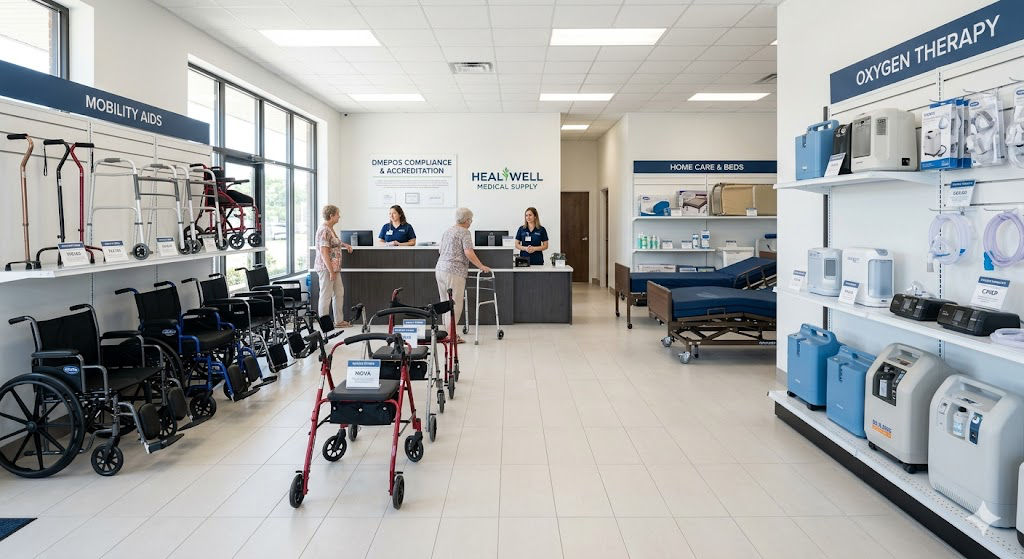
If your business supplies durable medical equipment, prosthetics, orthotics, or medical supplies to Medicare patients, you cannot participate in the Medicare program without a surety bond on file with your enrollment contractor. Not later. Not after your first billing cycle. Before your enrollment is complete, before you receive your Medicare billing privileges, before you collect a single dollar from the program. A $50,000 surety bond per National Provider Identifier is the price of admission — and understanding how it works, when it can increase, and what happens if it lapses is the difference between seamless enrollment and a revoked billing number.
What Is a DMEPOS Bond?
A DMEPOS bond — also called a Medicare bond, Medicaid bond, or CMS bond — is a federally mandated surety bond required of suppliers of Durable Medical Equipment, Prosthetics, Orthotics, and Supplies (DMEPOS) who participate in the Medicare program. It is a three-party financial guarantee between:
- The Principal — the DMEPOS supplier purchasing the bond
- The Obligee — the Centers for Medicare & Medicaid Services (CMS), the federal agency requiring and enforcing the bond
- The Surety — the bonding company that issues the bond and guarantees the principal’s compliance with Medicare program requirements
The bond’s purpose is direct: it protects the Medicare program from financial losses caused by fraudulent billing practices, erroneous payments, and supplier noncompliance. If a supplier submits inaccurate billing statements, fails to meet Medicare program obligations, or incurs civil monetary penalties they cannot or will not pay, CMS or a designated contractor can seek payment from the surety up to the full bond amount. The surety is then required to pay that amount within 30 days of receiving written notice from CMS. The supplier is then legally obligated to reimburse the surety in full.
The requirement has been in place since the Centers for Medicare & Medicaid Services published a final rule in the Federal Register on January 2, 2009, implementing Section 4312(a) of the Balanced Budget Act of 1997. Congress enacted the requirement after identifying a sustained pattern of improper and fraudulent payments to medical equipment suppliers that resulted in significant financial losses to the Medicare Trust Fund and compromised patient care.
Who Needs a DMEPOS Bond?
The bond requirement applies to any individual or business entity that sells or rents Medicare Part B covered items to Medicare beneficiaries. This is a broad category that includes:
| Supplier Type | Examples |
|---|---|
| Durable medical equipment suppliers | Wheelchair vendors, hospital bed suppliers, mobility aid companies |
| Oxygen and respiratory equipment suppliers | Home oxygen providers, CPAP suppliers |
| Prosthetics and orthotics suppliers | Prosthetic limb providers, brace and support manufacturers |
| Medical supply companies | Wound care supply distributors, diabetic supply companies |
| Pharmacies | Pharmacies dispensing covered DME or supplies to Medicare patients |
| Dental offices | Dentists billing Medicare for qualifying DME-related items |
| Personal care agencies | In some cases, agencies providing home care to Medicare patients |
| Pharmaceutical companies | Companies selling covered supplies to the Medicare program |
The bond requirement also extends to Medicaid — suppliers accepting Medicaid payments for qualifying products are similarly subject to state-level bonding requirements where applicable.
Who Is Exempt From the DMEPOS Bond Requirement?
Not all DMEPOS suppliers must post a bond. CMS has established specific exemptions:
- Government-operated suppliers that have provided CMS with a comparable surety bond under state law, where the bond states CMS is an obligee
- Pharmacies and pharmaceutical companies that sell to Medicare
- State-licensed orthotic and prosthetic personnel in private practice who make custom orthotics and prosthetics, provided the business is solely owned and operated by those personnel and bills only for orthotics, prosthetics, and related supplies
- Physicians and nonphysician practitioners (including nurse practitioners and clinical nurse specialists) who provide DMEPOS items solely to their own patients as part of their professional services
- Physical and occupational therapists in private practice, under the same conditions as the orthotic and prosthetic exemption — solely owned and operated, billing only for items furnished to their own patients
- Dentists, medical centers, hospitals, clinics (including sleep clinics), when DMEPOS items are provided solely as part of their professional services
- Optical suppliers, optometrists, and ophthalmologists providing eyeglasses and eye prosthetics
- Providers of mastectomy supplies meeting comparable conditions
If a previously exempt supplier no longer qualifies for an exemption — due to a change in ownership structure, a change in billing practices, or any other qualifying change — they must secure a Medicare bond within 60 days to remain compliant with CMS regulations.
How the Bond Amount Is Determined
The standard bond amount is $50,000 per National Provider Identifier (NPI). This is the flat federal requirement for most suppliers. But the standard $50,000 is not always the ceiling.
Multi-location suppliers must obtain a separate $50,000 bond for each NPI they maintain. A supplier operating 10 locations, each with its own NPI, carries $500,000 in total bond obligations. A 20-location operation carries $1,000,000. Alternatively, suppliers can obtain a single comprehensive bond covering all locations, rather than managing individual bonds per NPI — a meaningful administrative simplification for larger operations.
Adverse legal action escalation is the provision most applicants never learn about until it is already relevant: the statute requires an additional $50,000 bond for every adverse legal action that has occurred within the past 10 years. An adverse action includes prior Medicare revocations, legal violations, and similar regulatory history. A supplier with two adverse actions within the last decade must post $150,000 in total bond coverage — $50,000 baseline plus $100,000 for the two prior actions — before enrollment can proceed.
For suppliers deemed high risk based on their compliance history, CMS may require bond amounts above the standard threshold for additional protection.
Bond Amount Summary:
| Scenario | Total Bond Required |
|---|---|
| Single location, no adverse actions | $50,000 |
| 5 locations, no adverse actions | $250,000 |
| 20 locations, no adverse actions | $1,000,000 |
| Single location, 1 adverse action (past 10 years) | $100,000 |
| Single location, 2 adverse actions (past 10 years) | $150,000 |
| 3 locations, 1 adverse action (past 10 years) | $200,000 |
How Much Does a DMEPOS Bond Cost?
The annual premium is a percentage of the required bond amount, determined primarily by the credit profile of the business owners. DMEPOS bonds are federal compliance bonds with a relatively straightforward underwriting process — in most cases, a one-page application with a soft credit pull is sufficient. The soft pull does not affect the applicant’s credit score.
| Credit Score | Annual Cost (per $50,000 bond) | Monthly Cost |
|---|---|---|
| 680+ | $250 | $25 |
| 650–679 | $500 | $50 |
| 625–649 | $1,000 | $100 |
| 600–624 | $1,250 | $125 |
| 550–599 | $1,500 | $150 |
| 500–549 | $2,000 | $200 |
For applicants with excellent credit, annual premiums can fall as low as 0.5%–2% of the bond amount. The overall range across all credit profiles runs from approximately 0.5%–5% annually. Monthly payment options are available from some surety providers for applicants who prefer that structure.
For larger bond amounts driven by multiple locations or adverse legal actions, the premium calculation scales proportionally. A supplier required to post $150,000 in total coverage can expect an annual cost of approximately $750–$7,500 depending on their credit profile.
The DMEPOS Bond and the Competitive Bidding Program
There is a second DMEPOS bond that most enrollment guides never mention: the bid surety bond required for participation in the DMEPOS Competitive Bidding Program (CBP). This is a distinct instrument from the enrollment bond, and its requirements are governed by 42 CFR §414.412(g) rather than 42 CFR §424.57.
Under the Competitive Bidding Program, suppliers who wish to submit bids to become contract suppliers for specific Medicare product categories in designated Competitive Bidding Areas (CBAs) must post a separate $50,000 bid surety bond for each CBA for which they submit a bid. The next round of the DMEPOS CBP is currently underway, with product categories including Class II Continuous Glucose Monitors and Insulin Pumps, Urological Supplies, Ostomy Supplies, Hydrophilic Urinary Catheters, Off-the-Shelf Back Braces, Knee Braces, and Upper Extremity Braces. Contracts are targeted to be awarded and in effect by January 1, 2028.
CMS reviews each bid surety bond for deficiencies and allows bidders a 10-business-day window to submit a correcting rider. Bidders that want to participate in competitive bidding must plan for these bond requirements in addition to their standard Medicare enrollment bond obligations.
What Happens if Your Bond Lapses
A lapse in DMEPOS bond coverage is not a paperwork inconvenience — it is a billing privileges event. If the bond is cancelled, not renewed, or otherwise lapses while the supplier is enrolled in Medicare, CMS can and will revoke the supplier’s Medicare billing privileges. Once revoked, the supplier cannot receive Medicare reimbursement until the bond is reinstated and enrollment is brought back into compliance. The financial impact of a billing privileges gap can be immediate and severe for practices dependent on Medicare revenue.
Bonds must be submitted with the initial enrollment application and maintained continuously throughout participation in the Medicare program.
The Full DMEPOS Medicare Enrollment Process
The bond is one step in a multi-step enrollment process. Understanding where it fits helps suppliers plan their timeline:
| Step | Action |
|---|---|
| 1 | Obtain DMEPOS accreditation from a CMS-approved organization |
| 2 | Obtain an NPI for each practice location (via NPPES) |
| 3 | Complete the PECOS enrollment application and Electronic Funds Transfer Authorization (CMS-588) |
| 4 | Pay the Medicare Application Fee ($688 as of 2023) |
| 5 | Work with your enrollment contractor (NPE East or NPE West) on application status |
| 6 | Post the surety bond to your enrollment contractor |
| Ongoing | Report any changes within 30 days; revalidate enrollment every 3 years |
An important note on enrollment contractors: effective November 7, 2022, the National Supplier Clearinghouse (NSC) no longer processes Medicare enrollment applications for DMEPOS suppliers. All applications are now processed by the National Provider Enrollment DMEPOS East contractor (Novitas) and National Provider Enrollment DMEPOS West contractor (Palmetto). Submitting bond documents to the old NSC address will delay your enrollment.
Additionally, CMS requires DMEPOS suppliers enrolling in Medicare to obtain comprehensive liability insurance with a minimum limit of $300,000. For suppliers that manufacture their own items, this coverage must include product liability and completed operations. This insurance requirement is separate from and in addition to the surety bond requirement — both must be in place before enrollment is complete.
How to Get a DMEPOS Bond
Getting your DMEPOS bond is a fast process for most applicants. At Swiftbonds, the process runs four steps: Apply by completing a short online application that captures your business details, NPI information, the number of locations you operate, and your compliance history — including any adverse legal actions within the past 10 years. Receive your Quote quickly, typically the same day; for standard $50,000 bonds with good credit, the annual premium is often as low as $250. Pay your annual premium once you have confirmed your quote. File your bond — Swiftbonds prepares your executed bond document for submission to your enrollment contractor (NPE East or NPE West) along with the required power of attorney, ensuring the bond form meets CMS requirements so your enrollment can proceed without delay.
Swiftbonds LLC
2024 Surety Bond Provider of the Year
4901 W. 136th Street
Leawood KS 66224
(913) 214-8344
https://swiftbonds.com/
Frequently Asked Questions
What does DMEPOS stand for? Durable Medical Equipment, Prosthetics, Orthotics, and Supplies. Any business that sells or rents Medicare Part B covered items in these categories to Medicare beneficiaries is subject to the bond requirement.
How much does the DMEPOS bond cost? For a standard $50,000 bond with good credit (680+), the annual premium is approximately $250. Across all credit profiles, annual rates typically run from 0.5% to 5% of the bond amount. Applicants with poor credit may pay up to $2,000 or more annually per $50,000 bond.
Do I need a separate bond for each practice location? Yes, unless you obtain a single comprehensive bond covering all locations. The standard requirement is $50,000 per NPI. A supplier with five locations carrying five NPIs needs $250,000 in total coverage. Some suppliers simplify this by obtaining one bond covering all their NPIs rather than maintaining individual bonds.
What is the adverse action escalation rule? Federal statute 42 CFR §424.57 requires an additional $50,000 bond for every adverse legal action that has occurred within the past 10 years. A supplier with one prior adverse action must post $100,000 total. A supplier with two must post $150,000. This is one of the most commonly overlooked bond requirements in DMEPOS enrollment.
Does the bond affect my credit score? No. The credit check used in underwriting a DMEPOS bond is a soft pull, meaning it does not appear as a hard inquiry and does not affect the applicant’s credit score.
What happens if my bond lapses or is cancelled? CMS can revoke your Medicare billing privileges if your bond coverage lapses. Revocation cuts off Medicare reimbursement until enrollment is restored. To avoid this, the bond must remain continuously active throughout your participation in the Medicare program.
Is the DMEPOS bond the same as the Competitive Bidding Program bid bond? No. These are two separate bonds. The standard DMEPOS enrollment bond ($50,000 per NPI) is required for all participating suppliers under 42 CFR §424.57. The CBP bid bond ($50,000 per competitive bidding area) is a separate requirement under 42 CFR §414.412(g) for suppliers who wish to submit bids to become contract suppliers under the Competitive Bidding Program.
Are pharmacies required to get a DMEPOS bond? Yes, if the pharmacy sells or dispenses Medicare Part B covered DMEPOS items. Pharmacies are specifically listed among the supplier types subject to the bonding requirement. Some states, including Florida, Texas, and Minnesota, have also historically required their own state-level bonds for DMEPOS suppliers in addition to the federal requirement.
Where does the bond get filed? The completed bond form — including the power of attorney — should be submitted to your enrollment contractor. As of November 7, 2022, that is either NPE East (Novitas) or NPE West (Palmetto), depending on your geographic location. The NSC no longer accepts DMEPOS enrollment applications or bond submissions.
Conclusion
The DMEPOS bond is the financial gateway to Medicare participation for equipment and supply companies. At $50,000 per NPI for most suppliers — with mandatory escalation for adverse legal history and multi-location operations — it is one of the most structured federal surety bond requirements in the commercial bond market. The cost is modest for suppliers with clean credit: as little as $250 per year for a standard $50,000 bond. The compliance consequences of getting it wrong — a lapsed bond, an under-bonded enrollment, or missing the adverse action escalation — are not. Understanding the full scope of the requirement before you apply is far less expensive than discovering compliance gaps after you have already begun billing.
5 Things About the DMEPOS Bond You Will Not Find on Most Sites
- The DMEPOS bond requirement predates the CMS final rule by over a decade. Most content on this topic treats the January 2, 2009 Federal Register publication as the origin of the requirement. In fact, the bonding mandate was enacted as Section 4312 of the Balanced Budget Act of 1997 — passed by Congress more than 11 years before the final rule was published. The 1997 law authorized the $50,000 bond requirement and gave CMS the authority to implement it. The delay between enactment and implementation reflected years of regulatory development, public comment periods, and rulemaking. The 2009 final rule was not the creation of the requirement — it was the enforcement of one that had been law since the Clinton administration.
- DMEPOS suppliers are also required to maintain $300,000 in comprehensive liability insurance as a separate and independent prerequisite to Medicare enrollment — and this requirement changes if the supplier manufactures its own products. The surety bond and the liability insurance requirement are often conflated or one is omitted entirely. They are entirely separate obligations. The $300,000 comprehensive liability insurance minimum covers the supplier against third-party claims arising from its business operations. For suppliers that manufacture the DMEPOS items they sell or rent (rather than simply distributing them), the insurance must specifically include product liability coverage and completed operations coverage — a more demanding standard than the general liability minimum applicable to distributors and retailers. Failure to maintain either the bond or the insurance independently can compromise enrollment status.
- The DMEPOS bond is tied specifically to the National Provider Identifier — not to the business entity, the tax identification number, or the Medicare billing number. This NPI-based structure creates a compliance obligation that does not map cleanly onto how most businesses think about their legal identity. A single corporate entity operating under one tax ID can have dozens of NPIs across its practice locations, each requiring its own $50,000 bond coverage. Two suppliers with identical legal structures and revenue profiles can have radically different total bond obligations based solely on how many NPIs their operations require. For suppliers expanding to new locations, the bond requirement is triggered at the NPI level — meaning each new location that obtains its own NPI triggers a new $50,000 bond obligation before that location can begin Medicare billing.
- The surety company providing a DMEPOS bond must be certified by the U.S. Department of the Treasury — and using an uncertified surety will result in enrollment rejection. Unlike most commercial surety bonds, where state-licensed carriers are generally acceptable to obligees, the DMEPOS bond must be issued by a surety company that appears on the Treasury Department’s approved list under 31 CFR Part 223. This federal certification requirement is distinct from state insurance licensing. A surety company can be properly licensed in all 50 states and still be ineligible to issue a DMEPOS bond if it has not received Treasury certification. Suppliers who obtain their bond from a non-Treasury-approved carrier will have their enrollment application rejected on bond deficiency grounds — a costly delay that is entirely avoidable by verifying Treasury certification before purchasing the bond.
- The Competitive Bidding Program bid bond and the enrollment bond serve fundamentally different purposes and are enforced by different CMS regulatory frameworks — but both can be required of the same supplier simultaneously. A DMEPOS supplier that participates in the Competitive Bidding Program must post the standard $50,000 enrollment bond per NPI under 42 CFR §424.57 and a separate $50,000 bid surety bond per competitive bidding area under 42 CFR §414.412(g). These are not the same bond, they are not interchangeable, and they cannot satisfy each other’s requirements. For a supplier with five practice locations bidding in three competitive bidding areas, the total bond obligation could reach $400,000 — $250,000 for enrollment coverage plus $150,000 for bid coverage — before any adverse action escalation is applied. Few enrollment guides explain that these two bond types coexist and accumulate independently.