Maryland is turning away contractors, freezing auto dealer applications, and suspending mortgage broker licenses every month — all because one document is missing. A surety bond is not optional in the Old Line State. It is the financial guarantee that stands between your business and the right to operate legally, and in Maryland the stakes are higher than in most other states. Auto dealer bonds reach $300,000. Mortgage broker bonds can hit $750,000. Collection agency bonds can top $1,000,000. If you do business in Maryland, here is everything you need to know about surety bonds — what they are, who requires them, what they cost, and how to get yours today.
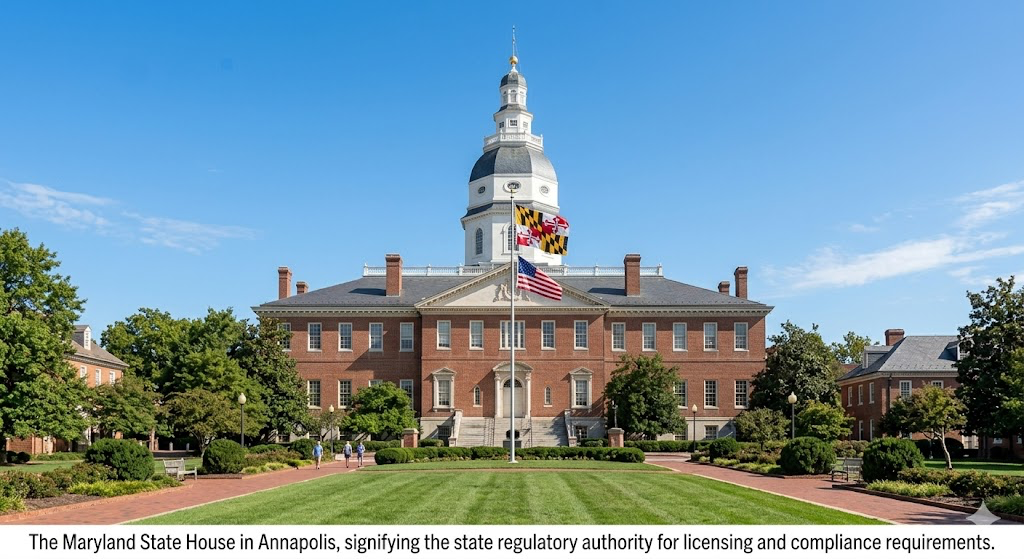
What Is a Surety Bond in Maryland?
A Maryland surety bond is a legally binding three-party contract that guarantees a business or individual will comply with state laws, fulfill contractual obligations, and protect the public from financial harm. The three parties are the principal (the business or individual required to obtain the bond), the obligee (the Maryland state agency or entity requiring the bond), and the surety (the bonding company that underwrites and backs the guarantee).
When the principal violates the law or fails to meet their obligations, the harmed party can file a claim against the bond. The surety investigates the claim and pays valid claims up to the full bond amount. The principal is then legally required to reimburse the surety for everything paid out. A surety bond is not insurance for your business — it is a financial guarantee on behalf of your business, and you bear ultimate responsibility for any claims paid in your name.
Maryland’s surety bond requirements are administered by multiple agencies. The Maryland Home Improvement Commission licenses home improvement contractors. The Commissioner of Financial Regulation oversees mortgage lenders, mortgage brokers, collection agencies, and credit services organizations. The Motor Vehicle Administration regulates auto dealers and title service agents. The Maryland Insurance Administration covers insurance-adjacent professionals. The Comptroller of Maryland handles alcohol, tobacco, and fuel tax bonds. The Maryland Public Services Commission regulates electricity and natural gas suppliers and brokers.
Common Maryland Surety Bonds and Their Amounts
The table below covers the most frequently required surety bonds in Maryland, the agency that mandates them, and the required bond amounts.
| Bond Type | Required By | Bond Amount |
|---|---|---|
| Freight Broker Bond (BMC-84) | FMCSA | $75,000 |
| Auto / Vehicle Dealer Bond | MD Motor Vehicle Administration | Up to $300,000 |
| Contractor License Bond | MD Home Improvement Commission | $30,000 or $100,000 |
| Mortgage Broker Bond | Commissioner of Financial Regulation | $50,000 – $750,000 |
| Mortgage Lender Bond | Commissioner of Financial Regulation | Varies by loan volume |
| Collection Agency Bond | Commissioner of Financial Regulation | $50,000 – $1,000,000 |
| Credit Services Organization Bond | Commissioner of Financial Regulation | $50,000 |
| Electricity & Natural Gas Supplier Bond | MD Public Services Commission | Varies |
| Title Service Agent Bond | MD Motor Vehicle Administration | Varies |
| Automobile Insurance Fund Producer Bond | Maryland Automobile Insurance Fund | Varies |
| Boat Dealer Bond | MD Dept. of Natural Resources | Varies |
| Health Club Bond | Consumer Protection Division | Varies |
| Employment Agency Bond | MD Dept. of Labor, Licensing & Regulation | Varies |
| Alcohol Tax Bond (Beer/Wine/Liquor) | Comptroller of Maryland | Varies |
| Direct Wine Shipper Bond | Comptroller of Maryland | Varies |
| Other Tobacco Products (OTP) Bond | Comptroller of Maryland | Varies |
| Motor Fuel Dealer/User/Seller Bond | Comptroller of Maryland | Varies |
| Wholesale Distributor Bond | Maryland Board of Pharmacy | Varies |
| Private Career School Bond | MD Higher Education Commission | Varies |
| Lottery Bond | Maryland State Lottery Agency | Varies |
| Investment Advisor Bond | Securities Commissioner | Varies |
| Surplus Lines Broker Bond | Maryland Insurance Administration | Varies |
| Nominal Bond of Personal Representative | Maryland Courts | Varies |
| Utility Deposit Bond | Baltimore Gas & Electric | Varies |
Maryland’s auto dealer bond reaches up to $300,000 — one of the highest dealer bond amounts in the country. The required amount scales with the dealer’s annual vehicle sales volume, as set by the Motor Vehicle Administration. Dealers with higher annual sales volumes are required to carry larger bond amounts.
Maryland’s mortgage broker and mortgage lender bonds scale similarly by loan volume. A mortgage broker originating a lower volume of loans may need only $50,000 in coverage, while a high-volume originator may be required to carry up to $750,000. The Commissioner of Financial Regulation establishes the required amount based on the licensee’s annual loan volume.
Maryland Home Improvement Contractor Bond
The Maryland Home Improvement Contractor Bond is the most widely discussed bond in this state and deserves its own explanation. Home improvement contractors are licensed by the Maryland Home Improvement Commission (MHIC), operating under the Maryland Department of Labor. All home improvement contractors must demonstrate financial solvency to qualify for the Maryland Home Improvement Guaranty Fund before being licensed.
Contractors who cannot meet the state’s financial solvency requirements must file a surety bond instead. The bond comes in two amounts. A $30,000 bond is required for contractors who cannot demonstrate financial solvency but still want to access the Guaranty Fund. A $100,000 bond is available as an alternative for contractors who prefer to file a bond rather than submit any financial statements at all.
The bond is issued for a 2-year term that aligns with the MHIC license cycle. Premiums for the $30,000 bond start at $900 for the full 2-year term. Premiums for the $100,000 bond start at $2,000.
The official bond form is titled the “Maryland Home Improvement Contractor’s Bond” and claims under this bond are paid to the Maryland Home Improvement Guaranty Fund — not directly to the harmed homeowner. The Guaranty Fund then compensates the homeowner for unworkmanlike, incorrect, or incomplete remodeling or construction work, up to a maximum of $30,000 or the amount the homeowner paid to the contractor, whichever is less.
This bond has a historically significant claims rate compared to most other license bonds in the country. That claims history means more underwriting scrutiny from most surety companies, and some applicants are denied through standard commercial channels before finding specialty markets that will accept their applications regardless of credit condition. If you have been denied the home improvement contractor bond elsewhere, Swiftbonds works with applicants across all credit profiles.
To apply for a home improvement contractor license in Maryland, you must have two years of education or training experience, complete the Home Improvement Commission Contractor and Salesperson Original Application, provide a Contractor’s Personal Financial Statement if applicable, purchase and file a surety bond in the correct required amount, pass the Home Improvement Commission Contractors’ Examination, and pay all applicable MHIC fees.
Maryland Electricity and Natural Gas Supplier Bond
Maryland requires electricity and natural gas suppliers and brokers to post a surety bond as a condition of operating in the state’s deregulated energy market, administered by the Maryland Public Services Commission. This is a bond type not required in most other states — a reflection of Maryland’s deregulated energy landscape and the consumer protection requirements tied to competitive electricity and gas supply. Bond amounts vary by supplier and are determined by the Public Services Commission based on the supplier’s operations.
Maryland Nominal Bond of Personal Representative
Before a personal representative can begin any fiduciary duties in a Maryland estate proceeding, Maryland courts require the filing of a Nominal Bond of Personal Representative. This court bond is a legal requirement that guarantees the personal representative will faithfully perform their duties under Maryland law. Bond amounts are determined by the court based on the value of the estate. This bond is distinct from probate bonds required in other states and is specific to Maryland’s estate administration framework.
How Much Does a Surety Bond Cost in Maryland?
Maryland surety bond premiums typically range from 1% to 10% of the total bond amount. Your credit score is the primary pricing factor for most standard license and permit bonds, with bond type, business history, and industry risk also influencing the final rate.
| Bond | Bond Amount | Credit 700+ | Credit 600–699 | Credit Below 600 |
|---|---|---|---|---|
| Freight Broker Bond (BMC-84) | $75,000 | $750 – $2,250 | $2,250 – $3,750 | $3,750 – $7,500 |
| Auto Dealer Bond | $300,000 | $3,000 – $9,000 | $9,000 – $15,000 | $15,000 – $30,000 |
| Contractor License Bond | $100,000 | $1,000 – $3,000 | $3,000 – $5,000 | $5,000 – $10,000 |
| Mortgage Broker Bond | $150,000 | $1,500 – $4,500 | $4,500 – $7,500 | $7,500 – $15,000 |
| Collection Agency Bond | $50,000 | $500 – $1,500 | $1,500 – $2,500 | $2,500 – $5,000 |
| Credit Services Organization Bond | $50,000 | $500 – $1,500 | $1,500 – $2,500 | $2,500 – $5,000 |
| Home Improvement Bond ($30,000) | $30,000 | $900 (2-yr term) | Varies | Varies |
Applicants with a credit score of 700 or higher typically qualify for rates at the low end of the range. Applicants with lower credit scores will pay higher premiums, generally 5% to 15% of the bond amount for the worst credit tiers, but bonding remains accessible. The Maryland Home Improvement Contractor Bond is an exception — it starts at a set premium of $900 for the 2-year term regardless of credit tier, though applicants with challenged credit may face additional underwriting requirements or program-specific pricing.
How to Get a Surety Bond in Maryland
Getting bonded in Maryland through Swiftbonds follows four straightforward steps.
First, apply. Submit your application online at https://swiftbonds.com/ with your business information, the bond type you need, and the required bond amount. The application takes only a few minutes. If you are unsure which bond applies to your license, contact the relevant Maryland obligee — the agency requiring the bond determines the exact bond form and the amount, and your bond must be issued in the same name and entity type as your license application.
Second, get your quote. Swiftbonds reviews your application and returns a quote, often instantly for standard license and permit bonds. For larger or more complex bonds such as mortgage lender, collection agency, or home improvement contractor bonds, a quote is typically returned within one business day.
Third, pay your premium. Pay securely online. Your bond is processed immediately after payment is received and delivered to you by email.
Fourth, file your bond. Submit your executed bond to the appropriate Maryland obligee — whether that is the Maryland Home Improvement Commission, the Commissioner of Financial Regulation, the Motor Vehicle Administration, the Maryland Insurance Administration, the Comptroller of Maryland, or another agency — to complete your licensing requirement.
Swiftbonds issues bonds backed by A-rated, Treasury-listed surety companies and works with applicants across all credit levels.
Swiftbonds LLC
2025 Surety Bond Agency of the Year
4901 W. 136th Street
Leawood KS 66224
(913) 214-8344
https://swiftbonds.com/
Frequently Asked Questions
What are the most common surety bonds required in Maryland? The most frequently required Maryland surety bonds are the Auto Dealer Bond (up to $300,000), Home Improvement Contractor Bond ($30,000 or $100,000), Mortgage Broker Bond ($50,000–$750,000), Freight Broker Bond ($75,000), Collection Agency Bond ($50,000–$1,000,000), and Credit Services Organization Bond ($50,000). Each is required by a different Maryland state agency, and each has its own bond form and filing requirements.
How does the Maryland Home Improvement Contractor Bond work? Maryland home improvement contractors who cannot meet the state’s financial solvency requirements must file a $30,000 surety bond with the Maryland Home Improvement Commission. Contractors who prefer not to submit any financial statements may instead file a $100,000 bond. The bond runs for a 2-year term aligned with the MHIC license cycle. Claims are paid to the Maryland Home Improvement Guaranty Fund, which compensates harmed homeowners up to $30,000 or the amount they paid to the contractor, whichever is less.
Why is Maryland’s auto dealer bond so high? Maryland’s auto dealer bond reaches up to $300,000, making it one of the highest in the country. The Motor Vehicle Administration sets the required bond amount based on the dealer’s annual vehicle sales volume. Higher-volume dealers are required to carry larger bond amounts to ensure adequate consumer protection relative to the scale of their operations.
How much does a Maryland mortgage broker bond cost? Maryland mortgage broker bonds range from $50,000 to $750,000 depending on the volume of loans originated annually, as determined by the Commissioner of Financial Regulation. At 1%–3% for applicants with good credit, a $50,000 bond may cost as little as $500 to $1,500 per year. A $750,000 bond at the same rate would cost $7,500 to $22,500 annually.
What is the Maryland Electricity and Natural Gas Supplier Bond? Maryland requires electricity and natural gas suppliers and brokers operating in the state’s deregulated energy market to post a surety bond with the Maryland Public Services Commission. This is a consumer protection measure that ensures suppliers comply with state energy regulations. Bond amounts are determined by the Commission based on each supplier’s operations. This bond type is not required in most other states.
What is the Nominal Bond of Personal Representative in Maryland? The Nominal Bond of Personal Representative is a court bond required by Maryland courts before a personal representative can begin administering a decedent’s estate. It guarantees that the personal representative will faithfully discharge their fiduciary duties under Maryland law. The bond amount is determined by the court based on estate value.
Can I get a Maryland surety bond with bad credit? Yes. Maryland surety bonds are available to applicants with all credit profiles. Lower credit scores result in higher premium rates, typically 5% to 15% of the bond amount, and some bond types may require additional underwriting documentation or collateral. Swiftbonds works with applicants across a full range of credit profiles. The Maryland Home Improvement Contractor Bond, which has a high industry-wide claims rate, may require specialty market placement for applicants who have been denied by standard markets.
How long does a Maryland surety bond last? Most Maryland license and permit bonds are issued annually and must be renewed to keep the associated license in good standing. The Maryland Home Improvement Contractor Bond is an exception — it runs for the full 2-year MHIC license term. Court bonds are case-specific and may have different duration requirements depending on the court’s instructions.
Conclusion
Maryland’s surety bond requirements are among the most extensive and financially significant in the country. Auto dealers carry bonds up to $300,000. Mortgage professionals can be required to carry up to $750,000. Collection agencies face bond requirements up to $1,000,000. Home improvement contractors navigate a two-tiered bond structure tied to one of the state’s most claims-active bond classes. Whatever bond Maryland requires for your business, the process starts with a fast, straightforward application. Visit https://swiftbonds.com/ to apply for your Maryland surety bond, receive your quote instantly, and get your bond delivered the same day.
Five Facts About Maryland Surety Bonds Not Found in the Top Ten Competitor Articles
- Maryland’s auto dealer bond reaches up to $300,000 and scales based on annual vehicle sales volume — making it one of the highest required auto dealer bond amounts in the United States — because the Motor Vehicle Administration calibrates the bond requirement to the financial exposure generated by a dealer’s actual transaction volume rather than setting a fixed flat amount.
- The Maryland Home Improvement Contractor Bond pays claims to the Maryland Home Improvement Guaranty Fund rather than directly to harmed homeowners — the Fund then compensates consumers up to $30,000 or the amount paid to the contractor — a two-step recovery mechanism that distinguishes Maryland from most other states where contractor bond claims are paid directly to the claimant.
- Maryland’s Nominal Bond of Personal Representative is a court-required surety instrument that must be filed before a personal representative can begin any fiduciary duties in a Maryland estate proceeding — a bond type specific to Maryland’s estate administration framework that is not commonly required under the same name in other states.
- Maryland imposes a surety bond requirement on electricity and natural gas suppliers and brokers through the Maryland Public Services Commission as part of the state’s deregulated energy market framework — a consumer protection measure not found in most other states and one of the few bond types in the country tied directly to energy market participation rather than a traditional professional license.
- The Maryland Home Improvement Contractor Bond carries a historically high industry-wide claims rate relative to most other license bonds in the country — a well-documented adverse selection dynamic that causes many standard surety markets to decline applicants in this bond class and pushes a significant portion of Maryland home improvement contractors into specialty surety programs that accept applicants regardless of credit condition.